
Perth Translation Services » Perth » City of Wanneroo Translation Services » City of Wanneroo Arabic Translation Service
City of Wanneroo Arabic Translation Services
 Get fast and professional translation services in City of Wanneroo. We have NAATI certified Arabic translators providing translation of all types of documents. These include confidential legal, financial and migration document translations.
Legal Contract Translation City of Wanneroo
Medical Translation City of Wanneroo
Get A Quick Quote
City of Wanneroo
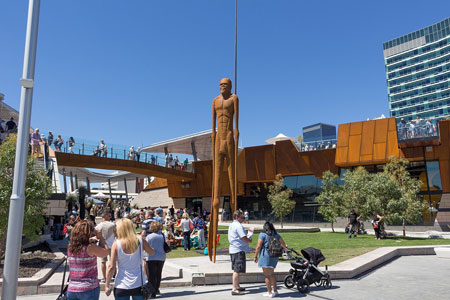
The City of Wanneroo is a local government area with city status in the northern suburbs of Perth, Western Australia. It is centred approximately 25 kilometres (15.5 mi) north of Perth's central business district and forms part of the northern boundary of the Perth metropolitan area.
City of Wanneroo History
Prior to 1902, Wanneroo was part of the Perth Road District, which eventually went on to become the City of Stirling. Wanneroo was established on 31 October 1902 as a road board under the Roads Act 1888. The board was named after the Wanneroo wetlands in the area, first explored and recorded by John Butler in 1834.
With the passage of the Local Government Act 1960, all road boards became shires effective from 1 July 1961, and the Shire of Wanneroo came into being, encompassing everything north of Beach Road and west of Alexander Drive. With the development of and subsequent population growth surrounding Joondalup, the Shire of Wanneroo attained City status on 31 October 1985.
City of Wanneroo Suburbs
The City of Wanneroo includes the suburbs and localities of Alexander Heights, Alkimos, Ashby, Banksia Grove, Butler, Carabooda, Carramar, Clarkson, Darch, Eglinton, Girrawheen, Gnangara, Hocking, Jandabup, Jindalee, Koondoola, Landsdale, Madeley, Marangaroo, Mariginiup, Merriwa, Mindarie, Neerabup, Nowergup, Pearsall, Pinjar, Quinns Rocks, Ridgewood, Sinagra, Tamala Park, Tapping, Two Rocks, Wangara, Wanneroo, Woodvale (part) and Yanchep.About the Arabic Language
Arabic is a Central Semitic language that first emerged in Iron Age northwestern Arabia and is now the lingua franca of the Arab world. It is named after the Arabs, a term initially used to describe peoples living from Mesopotamia in the east to the Anti-Lebanon mountains in the west, in northwestern Arabia, and in the Sinai peninsula.
The sociolinguistic situation of Arabic in modern times provides a prime example of the linguistic phenomenon of diglossia, which is the normal use of two separate varieties of the same language, usually in different social situations. 'Tawleed' is the process of giving a new shade of meaning to an old classical word. For example 'Al Hatif' lexicographically, means the one whose sound is heard but whose person remains unseen. Now the term 'Al Hatif' is used for a telephone. Therefore, the process of 'tawleed' can express the needs of modern civilzation in a manner that would appear to be originally Arabic. In the case of Arabic, educated Arabs of any nationality can be assumed to speak both their school-taught Standard Arabic as well as their native, mutually unintelligible "dialects"; these dialects linguistically constitute separate languages which may have dialects of their own. When educated Arabs of different dialects engage in conversation (for example, a Moroccan speaking with a Lebanese), many speakers code-switch back and forth between the dialectal and standard varieties of the language, sometimes even within the same sentence. Arabic speakers often improve their familiarity with other dialects via music or film.
The issue of whether Arabic is one language or many languages is politically charged, in the same way it is for the varieties of Chinese, Hindi and Urdu, Serbian and Croatian, Scots and English, etc. In contrast to speakers of Hindi and Urdu who claim they cannot understand each other even when they can, speakers of the varieties of Arabic will claim they can all understand each other even when they cannot. The issue of diglossia between spoken and written language is a significant complicating factor: A single written form, significantly different from any of the spoken varieties learned natively, unites a number of sometimes divergent spoken forms. For political reasons, Arabs mostly assert that they all speak a single language, despite significant issues of mutual incomprehensibility among differing spoken versions.
From a linguistic standpoint, it is often said that the various spoken varieties of Arabic differ among each other collectively about as much as the Romance languages. This is an apt comparison in a number of ways. The period of divergence from a single spoken form is similar—perhaps 1500 years for Arabic, 2000 years for the Romance languages. Also, while it is comprehensible to people from the Maghreb, a linguistically innovative variety such as Moroccan Arabic is essentially incomprehensible to Arabs from the Mashriq, much as French is incomprehensible to Spanish or Italian speakers but relatively easily learned by them. This suggests that the spoken varieties may linguistically be considered separate languages.
City of Wanneroo Arabic Translator Services
Arabic translator for certified translation services:
- Arabic driving license translation
- Arabic financial translation and bank statement translations
- Arabic birth certificate translation
- Arabic marriage certificate translation
- Arabic name-change certificate translation
- Arabic degree translation
- Arabic diploma translation
- Arabic school transcript translation
- Arabic passport translation
- Arabic police report translation
- Arabic police check translation
- Arabic personal letters and cards
- Arabic utility bill translations
- Arabic death certificate translation
Perth Translation provides fast and affordable Arabic translation services in the City of Wanneroo for all types of personal documents by NAATI translators.
Arabic Document Translation
While Modern Standard Arabic (MSA) is used across all Arabic-speaking countries for official documentation, significant regional variation exists in administrative terminology between Maghreb countries (Morocco, Algeria, Tunisia), Levantine states (Syria, Lebanon, Jordan), and Gulf nations. Egyptian Arabic administrative conventions are distinct again, and Iraqi documents may contain terminology unique to that country's legal system. These differences affect how identical document types are titled, structured, and formatted.
Arabic Document Types
Common Arabic civil documents include shahaadat al-milaad (birth certificate), aqd az-zawaaj (marriage contract), and rukhsat al-qiyaada (driving licence). Naming conventions vary by country; for example, marriage documents may be called wathiiqat zawaaj in some jurisdictions.
Where Arabic Is Official
Arabic is the sole or co-official language of 25 countries spanning North Africa and the Middle East, and is one of six official languages of the United Nations. Each country maintains its own bureaucratic conventions and document formats, meaning a birth certificate from Morocco differs substantially in layout and terminology from one issued in Saudi Arabia or Iraq. This breadth means Arabic document translation requires country-specific knowledge, not just language proficiency.
Multiple romanisation systems exist for Arabic, including the UN-recommended UNGEGN system, the Library of Congress standard, and various national conventions. Personal names on Arabic documents are often already transliterated into Latin script using inconsistent methods, and translators must carefully match existing passport romanisations to maintain identity document consistency.
About City of Wanneroo
The City of Wanneroo extends across approximately 685 square kilometres north of Joondalup, with a population exceeding 220,000 and growing rapidly. It is one of the fastest-growing municipalities in Australia, with large-scale residential development in suburbs like Alkimos, Yanchep, and Two Rocks, while the eastern portions remain rural and semi-rural.
Key suburbs include Wanneroo, Alkimos, Yanchep, Clarkson, Butler, Banksia Grove, Tapping, and Landsdale, with the Wanneroo town centre and Clarkson as the main commercial areas.
Council administration is based on Dundebar Road in Wanneroo, with libraries at Wanneroo, Clarkson, and Girrawheen. The Wanneroo Aquamotion and Kingsway Indoor Stadium provide sports and recreation, and Yanchep has a growing community hub to service the northern growth corridor.
The Joondalup line extends to Butler, with future extension planned to Yanchep as part of METRONET. Wanneroo Road and Mitchell Freeway are the principal north-south corridors, and Ocean Reef Road and Joondalup Drive provide east-west connectivity.
